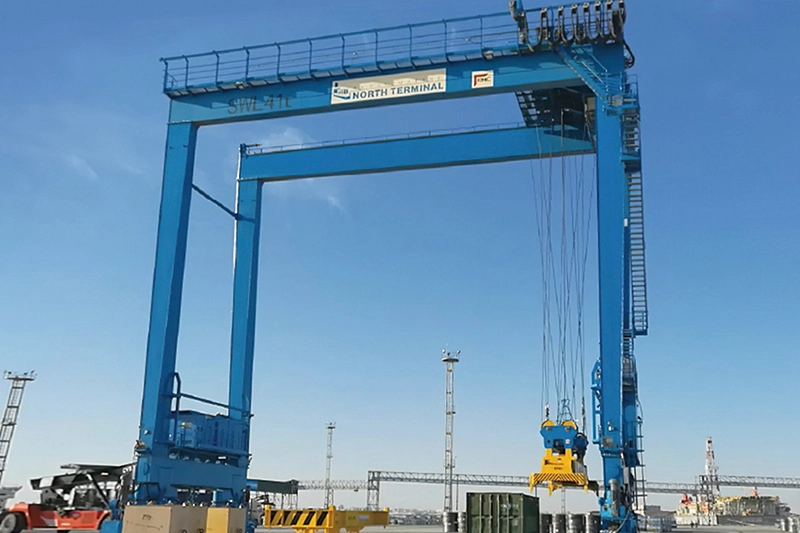
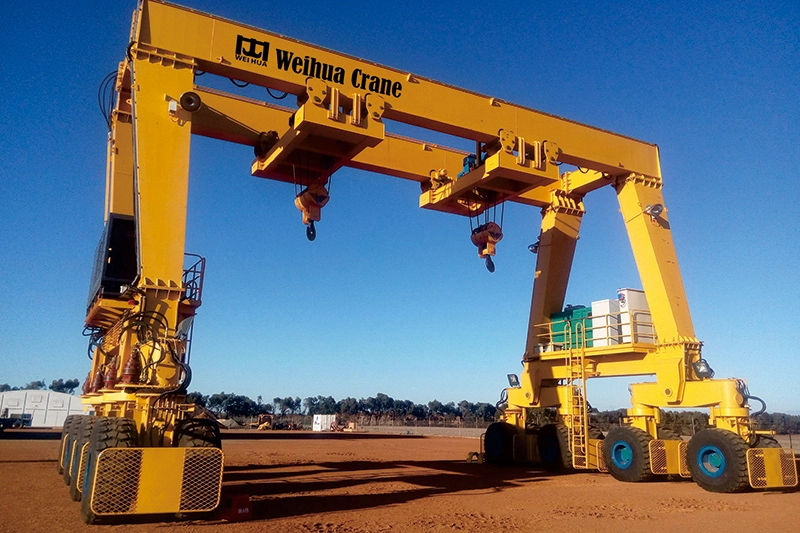
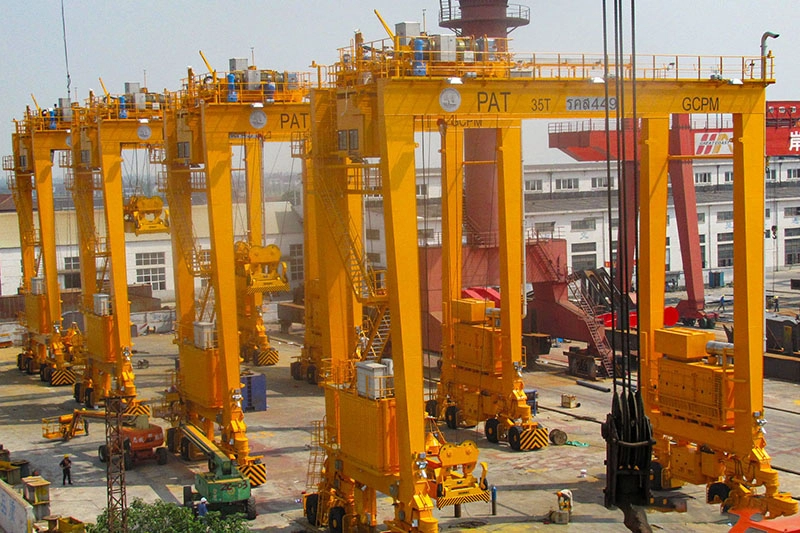
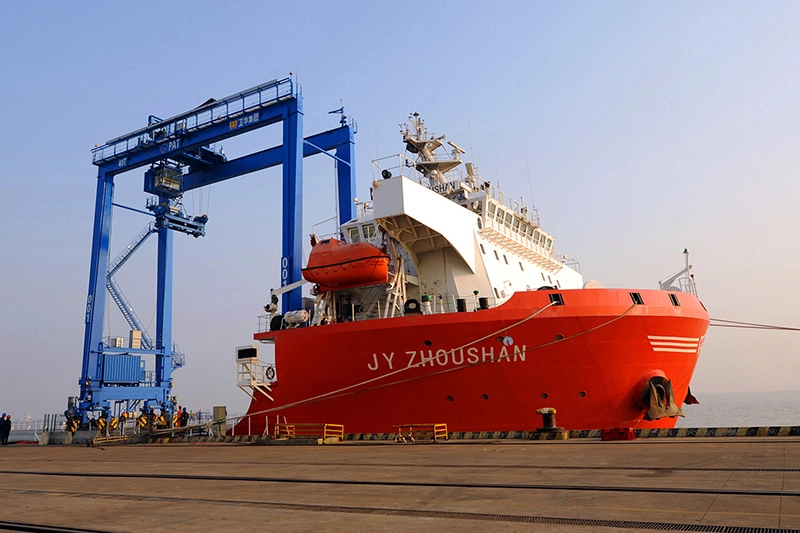
Weihua Rubber-Tyred Gantry Crane (RTG), also known as a rubber-tired container gantry crane, is a specialized container stacking and handling equipment launched by Weihua Group for port terminals, container yards, and railway transfer stations. This product is supported on inflatable rubber tires and is primarily driven by a diesel generator set. It can also be configured with cable reels, mains power, or lithium batteries according to customer needs. It is a highly mobile and adaptable container lifting machine.
As a core operating equipment in container yards, RTGs are widely used in port terminals, container yards, railway container transfer stations, and highway container transfer stations, undertaking key tasks such as container stacking, handling, and loading/unloading. Designed, manufactured, and inspected according to advanced domestic and international standards such as DIN, FEM, IEC, AWS, and GB, the product boasts stable performance, long service life, high production efficiency, and low sensitivity to ground unevenness.
Structurally, the rubber-tired gantry crane mainly consists of a trolley traveling mechanism, a trip trolley traveling mechanism, a gantry frame, a power supply system, and specialized container spreaders. The gantry consists of a U-shaped frame and a base beam, supported by inflatable rubber tires, and travels along designated aisles. The machine features multiple travel modes, including straight travel, lateral travel, 0-90° turning, and stationary turning, allowing for flexible and convenient site changes.
Depending on the lifting capacity, standard RTGs range from 35 to 65 tons, with a span covering six rows of containers plus a truck aisle (approximately 23.5 meters), and a stacking height of up to 6 or more layers (6 layers stacked, 7 layers passable). The product can lift 20-foot, 40-foot, and 45-foot standard containers and hydraulic storage tanks, employing specialized container spreaders and equipped with a comprehensive anti-sway system, safety indicators, and overload protection devices to ensure the safety of operators and equipment.
| Rate Capaticy | 100t |
| Span | 7m(Net span5.4m) |
| Hoisting Height | 5.75m |
| Hoisting Speed | 0~1m/min Heavy load |
| 0~2m/min Empty load | |
| Gradeability | 2.5% |
| Travelling Speed | 0~25m/min Heavy load |
| 0~45m/min Empty load | |
| Arches Loading | 42500kg |
| Grounde Press | <0.9kg/cm2 |
| Road Condition | matfess,pressed gravel |
| Tire type/no. | 18.00-25/8 |
| Driving wheel/Driven wheel | 2/2 |
| Extenal Dimension | lenght 11.5mxwidth 9.1mXheight 9.15m |
| Total Power | 85kw Power supplyed by diesel engine |
| Control Model | Cab and remote control |
| Transmission Model | all device driven by hydraulic system |
| Steering Model | 360° rotation,all wheel steering |
1. Port Container Terminals
Roller-tired gantry cranes (RTGs) are the core yard equipment of modern container terminals, and their application spans the entire terminal operation process:
Typical Operations:
Container yard retrieval after loading and unloading from container ships
Container sorting, overturning, and repositioning within the yard
Container pickup and loading operations by external container trucks
Loading, unloading, and transshipment of railway containers
Advantages:
Port container terminals typically have high operational density and fast turnaround times. RTGs require no track laying and can be flexibly deployed according to the terminal layout; their omnidirectional mobility allows for high-density stacking and efficient flow of containers within limited yard space. A standard configuration can cover the operating width of 6 rows of containers plus one truck aisle, with stacking heights reaching 5+6 or 6+7 meters, significantly improving the land utilization rate of the terminal yard.
Typical Cases:
Many large container terminals worldwide use RTGs as their primary yard equipment. Through the accompanying Operations Optimization and Scheduling System (RTG-O), terminals can significantly improve equipment utilization, shorten waiting times for external container trucks, and reduce fuel consumption.
2. Railway Container Terminals
With the development of multimodal transport, the volume of railway container transport continues to grow, making the demand for efficient and flexible yard equipment at railway container terminals increasingly urgent.
Typical Operations:
Loading and unloading of railway container trains
Short-haul transshipment of containers between railway lines and the yard
Storage and organization of containers
Application Advantages:
Railway container yards typically have long operating areas and relatively complex site conditions. The tire-mounted RTG system requires no track constraints and can be flexibly deployed along the railway line; its oblique travel and turning capabilities allow it to adapt to operational needs in different directions. Plug-in RTGs (electrically powered reel-type generators) reduce operating costs while meeting the special environmental and noise control requirements of railway terminals.
3. Inland Container Yards and Logistics Parks
Inland logistics parks, container yards, and export bonded warehouses are important application scenarios for RTGs:
Typical Operations:
Empty container storage, retrieval, and management in empty container yards
Temporary storage and transshipment of loaded containers in loaded container yards
Container inspection, cleaning, and maintenance support
Application Advantages:
Inland container yards typically have relatively limited investment budgets, requiring high cost-effectiveness from equipment. RTGs do not require complex track infrastructure construction, resulting in relatively low equipment investment and site preparation costs. Diesel generator sets provide power, eliminating limitations on mains power access and allowing for flexible adjustment of operating areas based on business development. Furthermore, RTGs possess good site adaptability, enabling normal operation on relatively uneven hardened surfaces.
4. Multimodal Transport Hubs
Multimodal transport hubs (road-rail-water) require equipment capable of efficiently connecting and transferring containers between different modes of transport:
Typical Operations:
Container transshipment between road trucks and rail trains
Container transfer between waterway barges and road transport
Container management at the hub yard
Advantages:
Multimodal transport hubs typically cover multiple connection points for road, rail, and water transport, resulting in complex site layouts. RTGs' omnidirectional mobility and relocation capabilities allow for flexible scheduling between different operating areas. A single set of equipment can cover multiple operational scenarios, improving equipment utilization and return on investment.
5. Shipbuilding and Heavy Equipment Industry
Besides container handling, rubber-tired gantry cranes (RTGs) are widely used in heavy material handling in industries such as shipbuilding, wind power equipment, and steel structure manufacturing.
Typical Operations:
In-plant transfer of ship sections and steel plates
Lifting and transporting large components such as wind turbine blades and towers
Assisting in the loading, unloading, and assembly of heavy steel structural components
Advantages:
Compared to rail-mounted gantry cranes, the rubber-tired system of RTGs allows them to move freely within the factory area, covering a larger operating range. For heavy manufacturing scenarios requiring frequent changes in work location, RTGs offer significant flexibility advantages.
1. Company Overview and Industry Position
Henan Weihua Heavy Machinery Co., Ltd., founded in 1988, is a core holding subsidiary of Weihua Group. Headquartered at No. 18 Shanhai Avenue, Changyuan City, Henan Province, known as the "Capital of Lifting Machinery in China," the company boasts a registered capital of RMB 1.066 billion. It is a leading enterprise in China's crane manufacturing industry and one of the world's largest industrial crane manufacturers. As a national manufacturing single-item champion enterprise, Henan Weihua holds a significant position in the domestic and international lifting machinery industry.
2. Main Business and Product System
The company focuses on the research, development, manufacturing, and sales of bridge cranes, gantry cranes, electric hoists, and new intelligent lifting equipment. Product types cover multiple series including general-purpose bridge cranes, European-style cranes, metallurgical cranes, explosion-proof cranes, and port gantry cranes, meeting the complex operational needs of various industries. With its modular, lightweight, and intelligent design concepts, Henan Weihua's products are at the forefront of the industry in terms of structural performance, safety, reliability, and service life.
3. Application Areas and Market Coverage
Henan Weihua's products are widely used in many key sectors of the national economy, including machinery manufacturing, metallurgy, power energy, port logistics, railway transportation, petrochemicals, and construction engineering. The company's products not only sell well in all provinces, municipalities, and autonomous regions of China, but are also exported to more than 100 countries and regions in Southeast Asia, the Middle East, Africa, Europe, and the Americas, serving numerous Fortune 500 companies and key national engineering projects, earning a good international reputation.
4. Technology R&D and Quality Assurance
The company highly values technological innovation and has established several high-end R&D platforms, including a national-level enterprise technology center, a postdoctoral research station, and the Henan Provincial Lifting Machinery Engineering Technology Research Center. In recent years, Henan Weihua has actively promoted intelligent and digital manufacturing transformation, accumulating over a thousand national authorized patents and participating in the formulation of multiple national and industry standards. In terms of quality management, the company has passed ISO9001, ISO14001, and ISO45001 international system certifications and has successively won numerous honors such as "China Famous Brand Product," "National Quality Benchmark," and "National Technological Innovation Demonstration Enterprise," establishing a comprehensive quality control system from raw materials to finished products.