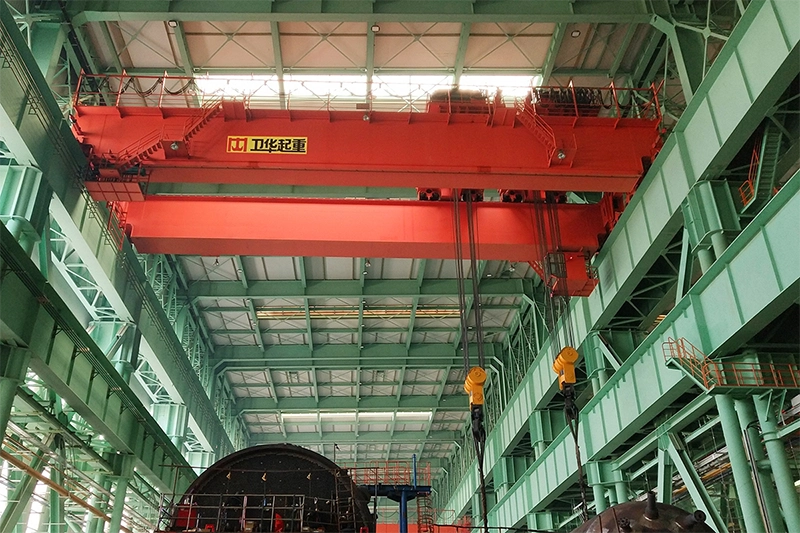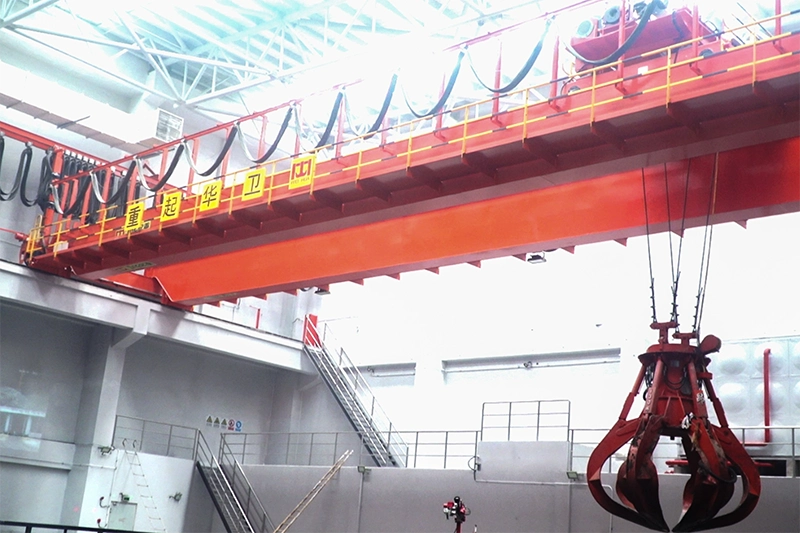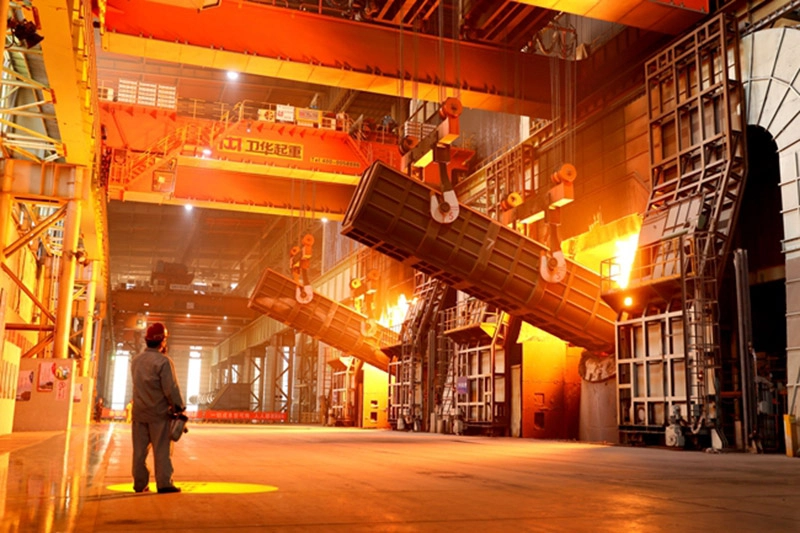
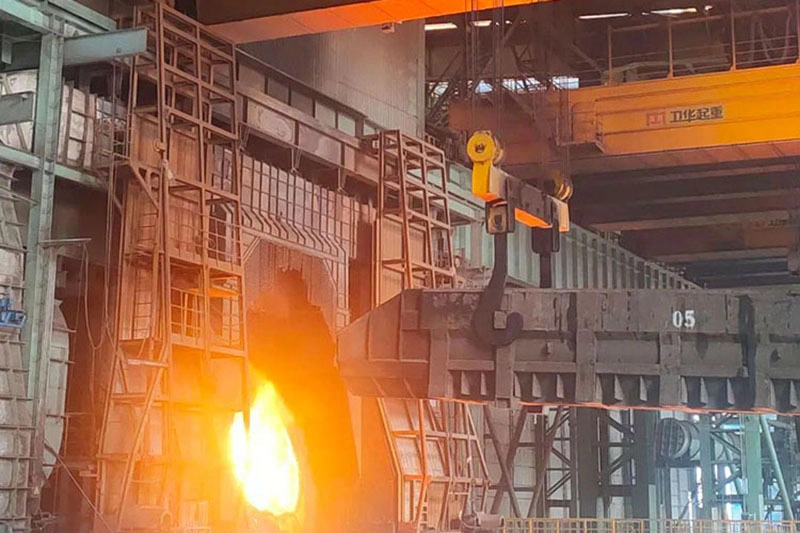
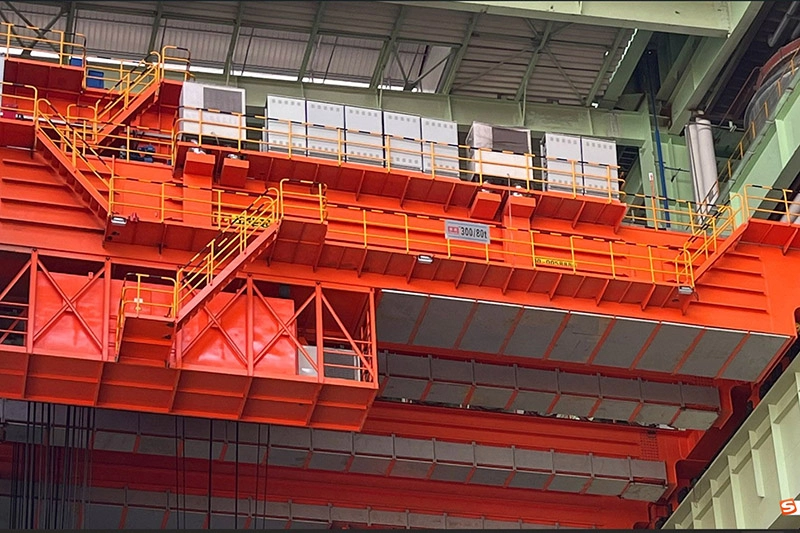
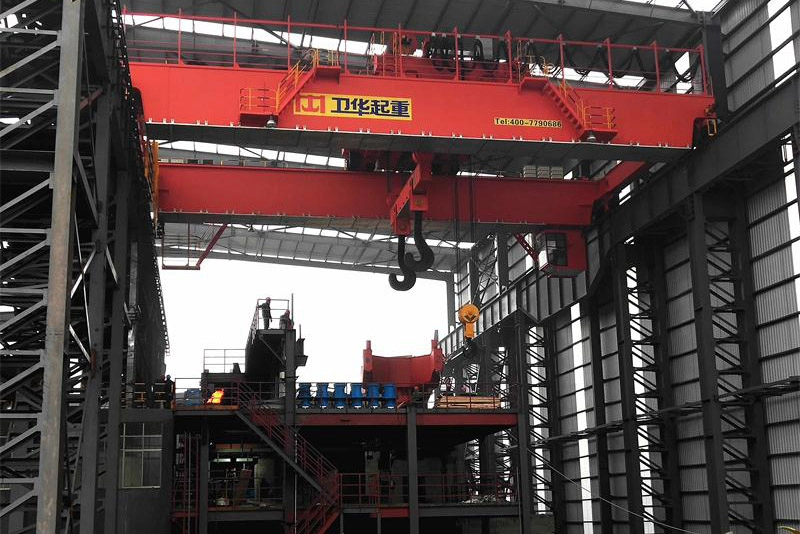
The Weihua QDY type metallurgical bridge crane is a specialized lifting device developed by Weihua Group for high-temperature and heavy-duty operations in metal smelting, casting, rolling, and hot processing. Using a hook as the primary lifting device, it is specifically designed for lifting molten metal (such as molten steel, iron, and copper), incandescent solid metals, and other high-temperature materials. As a core piece of equipment for material handling in the metallurgical industry, the QDY type metallurgical crane plays an irreplaceable role in key processes in steel smelting, non-ferrous metal processing, and foundry workshops.
Technically, the QDY type metallurgical crane belongs to the double-girder bridge crane series and is an important member of Weihua's metallurgical crane product matrix. Compared to the QZ type grab bucket crane (bulk material handling) and the QD type hook crane (general purpose), this product has been specifically enhanced in terms of structural design, material selection, and safety configuration to address the unique characteristics of metallurgical operations, possessing core performance features such as high temperature resistance, dust resistance, high reliability, high stability, and precise speed regulation.
Structurally, the Weihua QDY type metallurgical bridge crane mainly consists of the following parts:
Bridge System: A double-main-girder box-shaped welded structure, characterized by high rigidity, light weight, and good stability. A heat insulation device is added to the bottom of the main girder to effectively block radiant heat from the molten metal below.
Trolley Traveling Mechanism: Composed of a motor, reducer, and gear transmission system, enabling smooth movement along the plant's tracks.
Auxiliary Trolley Traveling Mechanism: Located on the bridge track, composed of a motor, reducer, gear transmission system, and trolley cantilever, enabling lateral movement of the hook.
Hoisting Mechanism: Equipped with a dedicated metallurgical-grade hoisting system, including a motor, reducer, drum assembly, wire rope, pulley block, and dedicated hook assembly.
Electrical Control System: Employs a PLC + touchscreen control system, supporting variable frequency speed regulation and intelligent monitoring.
Safety Protection Devices: Includes multiple safety features such as overload limiters, dual lifting limits, thermal insulation protection, and electrical interlocks.
In terms of technical parameters, the Weihua QDY series metallurgical bridge crane covers an ultra-wide range of lifting capacities from 5 tons to 320 tons, with mainstream specifications including 5t, 10t, 16/3.2t, 20/5t, 32/5t, 50/10t, 74/20t, and 100/20t. Spans range from 10.5 meters to 31.5 meters, with commonly used specifications including 10.5m, 13.5m, 16.5m, 19.5m, 22.5m, 25.5m, 28.5m, and 31.5m. Lifting heights range from 9 meters to 22 meters and can be customized. The working class is A7 and A8, suitable for frequent heavy-duty operations; models with a rated lifting capacity of less than 75 tons are also recommended.
Regarding applicable environmental conditions, this product is suitable for ambient temperatures from -10℃ to 60℃, with relative humidity not exceeding 50% at 40℃. The radiant temperature of the molten metal being hoisted on the hook shall not exceed 300℃. If this requirement is exceeded, it can be handled according to the terms of the purchase contract as per the user's requirements.
Regarding standard compliance, the design, manufacture, and inspection of the Weihua QDY type metallurgical bridge crane comply with JB/T7688.1-95 and JB/T7688.15-95 "Technical Conditions for Metallurgical Cranes" standards, and the assembly and testing comply with the requirements of the State Administration for Quality Supervision, Inspection and Quarantine document [2007]375. The product strictly adheres to relevant national and industry safety technical specifications, ensuring long-term stable operation of the equipment in high-temperature, heavy-load, and high-dust environments.
With over thirty years of experience in crane manufacturing and continuous technological innovation, Weihua Group has achieved numerous breakthroughs in the field of metallurgical cranes. In 2011, Weihua successfully developed the first fully automatic metallurgical loading bridge crane in China, breaking the foreign crane monopoly in this industry and filling a gap in the domestic crane manufacturing industry. In 2013, the achievement was appraised by the Henan Provincial Department of Science and Technology as reaching the international advanced level. Weihua owns several invention patents, including "Crane Anti-sway Control Method" and "An Anti-sway Lifting Mechanism," as well as several patented technologies such as "Crane Precision Automatic Positioning Control System" and "An Electric Slewing Mechanism," providing solid technical support for the efficient, precise, and safe operation of metallurgical cranes.
| Item | QDY |
| Loading capacity | 5 ~ 75 ton |
| Lifting height | Customized |
| Lifting speed | Varies with lifting capacity |
| Span | 10.5 ~ 31.5 m |
| Lifting mechanism | Winch trolley |
| Working class | A7/A8 |
| Working temperature | -20 ~ +60 ℃ |
| Power supply | AC-3Phase-220//230380/400/415/440V-50/60Hz |
| Control voltage | DC-36 / 48V |
| Motor protection class | IP54 IP55 IP65 |
| Control way | Cabin, wireless remote, pendant push button |
| Safety device | Buffer,current overload protection,overload device, power failure protection |
| Application area | Factory, workshop, warehouse, power station, logstic,etc. |
| Painting color | Yellow, Red or Customzied |
1. Special Design for Metallurgical Applications – High Temperature Resistance, Dust Resistance, and High Reliability
The core competitiveness of the QDY type metallurgical bridge crane stems from its specialized design for metallurgical casting conditions. Its structure, materials, and processes are all specifically reinforced for harsh conditions such as high temperatures, heavy loads, and high dust levels:
Three-Layer Synergistic Thermal Insulation System: Addressing the high-temperature radiation problem during molten metal hoisting, the Weihua QDY type metallurgical crane employs an innovative "three-layer blocking + structural cooling + material slow-attenuation" synergistic thermal insulation solution. A thermal insulation device is added to the bottom of the main beam to effectively block radiant heat from the molten metal below; key load-bearing components are designed for high temperatures to ensure structural strength in high-temperature environments; the control room and electrical cabinets are equipped with thermal insulation and heat dissipation measures to ensure stable operation of the electrical system.
High-Strength Box-Type Bridge Structure: Utilizing a double-main-beam box-type welded structure, it boasts advantages such as high rigidity, light weight, and good stability. The steel plates undergo shot blasting pretreatment, and the main welds are automatically welded using submerged arc welding and subjected to ultrasonic and X-ray non-destructive testing to ensure reliable welding quality. Through structural strength topology reconstruction design, self-weight optimization is achieved while ensuring load-bearing capacity.
Heavy-duty design: The overall working class is A7 or A8, suitable for heavy-duty operations with high frequency and high load utilization. All mechanisms undergo fatigue strength verification according to the heavy-duty system, and high-quality materials are selected for key components to ensure long-term reliability under frequent start-stop and high-load conditions. Models with a rated lifting capacity of less than 75 tons also refer to this standard.
Metallurgical-specific hoisting mechanism: The hoisting mechanism adopts a metallurgical-specific configuration, and key components (drum, wire rope, hook, etc.) are made of high-temperature resistant materials or undergo special treatment processes. High-temperature type wire ropes are selected or equipped with heat insulation protection to prevent performance degradation caused by high-temperature radiation.
2. Reliable safety protection system – multiple protections, strict standards
Safety is the primary consideration for metallurgical cranes. The Weihua QDY type metallurgical bridge crane has established a comprehensive safety protection system, fully complying with relevant national and industry safety technical specifications:
Dual Redundancy Design (Mechanical + Electrical):Key safety functions employ a dual redundancy configuration of mechanical and electrical components, ensuring that a single component failure will not lead to the loss of safety functions. The hoisting mechanism is equipped with normally closed brake devices on the high-speed shafts of the motor and reducer, which automatically close in the event of a power outage, ensuring reliable stopping of the load at any position.
Triple Protection Mechanism for Lifting: An innovative triple protection scheme is adopted, consisting of "double lifting limits + drum end rotation limit + trolley frame counterweight anti-overhead collision," effectively preventing hook over-winding and overhead collision accidents. This is a key safety feature that distinguishes metallurgical cranes from general-purpose cranes.
Heat Insulation Protection System: Heat insulation layers are installed at the bottom of the main beam and key areas to reduce the impact of molten metal heat radiation on the structure. For high-temperature environments where hot materials are lifted, reinforced heat insulation protection can be configured.
Overload Limiter: Equipped with a high-precision overload limiter, it monitors the lifting load in real time. When the load exceeds the rated lifting capacity, it automatically alarms and cuts off the lifting circuit to prevent overload accidents.
Electrical Safety Protection: The circuit is equipped with safety devices such as overcurrent protection, zero-position protection, emergency switch, and hopper door interlock switch. The variable frequency speed control system has comprehensive fault diagnosis and protection functions to ensure the safety and reliability of the electrical system.
Standard Compliance Verification: The crane assembly and testing comply with the requirements of the State Administration for Quality Supervision, Inspection and Quarantine's document [2007] No. 375, ensuring that the equipment meets all the requirements of the special equipment safety technical specifications. Strict adherence to JB/T7688.1-95 and JB/T7688.15-95 "Technical Conditions for Metallurgical Cranes" standards is enforced.
3. Intelligent Control System – PLC + Variable Frequency Drive, Precise and Efficient
The Weihua QDY metallurgical bridge crane adopts industry-leading technology in its electrical control system, achieving efficient, precise, and intelligent operation:
PLC Control System: Each crane is equipped with an independent PLC programmable controller for comprehensive monitoring and control. Centralized operation of all crane movements is possible from the control room, offering simple and intuitive operation.
Variable Frequency Speed Control: The hoisting, trolley travel, and main trolley travel mechanisms all utilize digital variable frequency speed control devices, achieving smooth starting and braking and precise speed control. Variable frequency speed control not only improves operational comfort but also significantly reduces mechanical shock and extends equipment lifespan.
Large and Medium Tonnage PLC + Variable Frequency Configuration: For large and medium tonnage cranes (e.g., 100t and above), the standard configuration is PLC + variable frequency speed control. Some mechanisms (such as hoisting) are also equipped with dual motors and dual reducers, further enhancing reliability and redundancy.
Modular Control System: With its modular structural design, the system can precisely provide a control system suitable for the user's working conditions and reserves interfaces for automation upgrades. Intelligent Management Functions: The control system features operational parameter recording, status monitoring, and fault diagnosis. Real-time monitoring of equipment operation is available through a human-machine interface, facilitating maintenance management and troubleshooting.
4. Quiet Transmission and Low Energy Consumption – Green Metallurgy, Cost Reduction and Efficiency Improvement
Weihua incorporates the principles of quiet operation, high efficiency, and energy saving in the transmission system design of its metallurgical cranes:
High-Quality Transmission Components: Gears are manufactured using low-carbon alloy forged steel, and grinding processes ensure higher tooth surface precision and lower transmission noise. Hardened tooth surface reducers offer strong load-bearing capacity, smooth transmission, and long service life.
Optimized Transmission Design: Multiple drive devices can be matched with motor power to reduce unnecessary energy loss. Lightweight design methods such as I-beams reduce the overall space occupied by the crane while increasing its usable height and coverage area.
Lightweight Structure: While ensuring load-bearing capacity, optimized structural design reduces the equipment's weight and drive power requirements, thereby reducing operating energy consumption.
Energy Feedback Technology (Optional): For metallurgical operations involving frequent starting and stopping, an optional energy feedback device can be installed to feed the regenerative energy generated during braking back to the power grid, further reducing energy consumption.
5. Fully Automated Operation Capability (High-End Configuration) – Leading Technology, Internationally Advanced
Addressing the automation needs of modern metallurgical production lines, Weihua, leveraging its deep technological accumulation in the field of metallurgical cranes, can provide high-end products with fully automated operation capabilities:
Internationally Advanced Level Certification: In 2013, Weihua's fully automated metallurgical loading bridge crane was appraised by the Henan Provincial Department of Science and Technology, which concluded that the achievement reached the international advanced level. This product broke the monopoly of foreign cranes in this industry and filled a gap in the domestic crane manufacturing industry.
High-Precision Positioning System: By combining a position coding system and an absolute encoder, dynamic three-dimensional coordinate real-time detection is achieved, realizing high-precision positioning. The related patented technology "Crane Precision Automatic Positioning Control System" (ZL2011204457249) has been granted a national patent.
Fully Automated Operation Process: The entire production line can be centrally controlled from the control room, achieving fully automated operation. Taking material loading as an example, a single material loading cycle is reduced from 40 minutes manually to 12 minutes, increasing work efficiency by 3-4 times.
Anti-sway technology: We have independently developed internationally leading electrical and mechanical anti-sway invention patents—"Crane Anti-Sway Control Method" (ZL201110336983.2) and "An Anti-Sway Lifting Mechanism" (ZL2011204457249)—solving the swaying problem during crane lifting.
Fully automatic lifting and detaching device: We have developed a fully automatic electric lifting and detaching device with a torque limiter. The related technology, "An Electric Slewing Mechanism" (application number: 201320466553.7), has been patented.
6. High Customization Capability – Adapting to Diverse Process Requirements
Metallurgical processes are complex and diverse. Weihua QDY-type metallurgical bridge cranes can be customized to meet the specific needs of different process stages:
Multiple Lifting Device Configurations: In addition to standard hooks, various lifting devices such as slab clamps, electromagnetic chucks, and grab buckets can be configured according to process requirements.
Multiple Lifting Mechanism Configurations (Double-Layer Chassis Trolley/Fixed Gantry Hook, etc.): For special conditions such as lifting molten steel ladles and molten iron ladles, a dedicated gantry hook lifting mechanism can be configured, employing a double-layer chassis trolley design to meet the needs of large-tonnage and long-distance operations.
Dedicated Lifting Tool Adaptation: Dedicated lifting tools and anti-detachment devices are customized according to the type of molten metal container being lifted (steel ladle, molten iron ladle, tundish, etc.).
Corrosion and Dust Protection Treatment: Special coating protection and sealing treatments can be configured for the dusty and corrosive environment of metallurgical workshops.
7. Comprehensive After-Sales Service Network – 24/7 Response
Comprehensive After-Sales Service: Weihua provides all-round service support including online after-sales, remote guidance, on-site repair, and regular follow-up visits. A professional technical team conducts regular on-site inspections to promptly identify potential equipment problems and optimize equipment parameters based on actual operating conditions. The service network covers the entire country, ensuring rapid response and safeguarding users' continuous production.
1. Iron and Steel Metallurgy Industry – Ironmaking, Steelmaking, and Continuous Casting Workshops
Iron and steel metallurgy is the core application area for QDY-type metallurgical bridge cranes. From the blast furnace tapping area to the converter steelmaking workshop, from the electric arc furnace steelmaking to the continuous casting workshop, and from the refining furnace to the molten steel receiving bay, metallurgical cranes are present throughout the entire iron and steel production process:
Typical Operations:
Blast Furnace Tapping Area: Lifting molten iron ladles to transport molten iron from the blast furnace to the steelmaking workshop or casting machine.
Converter Steelmaking Workshop: Lifting scrap steel baskets for charging operations; lifting molten steel ladles for converter iron charging; lifting molten steel ladles to the continuous casting rotary table.
Electric Arc Furnace Steelmaking Workshop: Lifting scrap steel baskets and molten iron ladles for electric arc furnace charging; lifting molten steel ladles to the continuous casting rotary table. Ladle tapping operations
Refining Workshop (LF/RH, etc.): Ladles are hoisted for refining, and steel composition adjustment and temperature control are performed in conjunction with the refining furnace.
2.Continuous Casting Workshop: Ladles are hoisted to the continuous casting rotary table; intermediate ladles are hoisted for preheating and replacement operations; billets are hoisted for removal from the production line.
Steel Receiving Bridge: Ladles are transferred between steelmaking and continuous casting.
Ingot Casting Workshop: Ladles are hoisted for ingot casting operations.
Configuration Advantages:
Iron and steel metallurgical workshops are characterized by high temperatures, high dust levels, and continuous operation. Weihua QDY type metallurgical cranes with a working class of A7/A8 can meet the requirements of 24-hour continuous production; a three-layer collaborative heat insulation protection system ensures the reliability of the equipment in high-temperature environments; multiple safety protection mechanisms meet the safety requirements of special equipment for hoisting molten metal. For large metallurgical workshops with a capacity of 100t or more, a main hook and auxiliary hook configuration (such as 100/20t, 160/40t, etc.) is adopted. The main hook is used for ladle hoisting, and the auxiliary hook is used for auxiliary operations, improving operational flexibility. II. Non-ferrous Metal Smelting – Copper, Aluminum, Zinc, etc. Smelting Workshops
Non-ferrous metal smelting (copper, aluminum, zinc, etc.) also requires specialized metallurgical cranes to handle the lifting of molten metal:
Typical Operations:
Copper Smelting: Lifting matte ladles, blister ladles, anode plates, etc.
Aluminum Smelting: Lifting molten aluminum ladles, assisting with slag removal, and transferring molten aluminum to the foundry.
Zinc Smelting: Lifting molten zinc ladles, assisting with ingot casting.
Configuration Requirements:
The temperature and corrosiveness characteristics of non-ferrous metal smelting vary. Weihua can provide customized designs based on the specific material characteristics. Molten aluminum corrodes iron containers, requiring specialized linings and protective measures.
3. Foundry Workshop – Ferrous and Non-ferrous Metal Casting
The foundry workshop is a typical application scenario for the QDY type metallurgical bridge crane, an indispensable core piece of equipment in the foundry production line.
Typical Operations:
Smelting Furnace Charging: Lifting furnace charge (scrap steel, pig iron, recycled materials, etc.) and adding it to the induction furnace or electric arc furnace.
Iron/Steel Transfer: Pouring molten metal from the smelting furnace into a ladle and lifting it to the pouring area.
Pouring Operation: Pouring molten metal from the ladle into sand molds or molds.
Casting Shaking and Cleaning: Lifting castings for sand shaking, cleaning, and transfer.
Sand Box and Mold Loading/Unloading: Lifting large sand boxes and molds.
Systematic Configuration Solution:
Foundry workshops are characterized by complex working conditions and limited space. The QDY metallurgical crane can be used with various non-standard lifting tools for lifting ladles and castings. The graded speed-changing lifting mechanism facilitates flow rate control during pouring, and the optional remote control system allows for precise operation at the pouring station. Related products are widely used in numerous foundry enterprises and workshops.
4. Rolling Mill and Forging Workshop – Hot Working Process Coordination
Rolling mills and forging workshops involve the handling and turning of large quantities of hot, solid metal:
Typical Operations:
Heating Furnace Loading and Unloading: Feeding steel billets into and removing them from the heating furnace.
Rolling Line Coordination: Lifting rolling mill components such as rolls and guides; lifting steel during rolling.
Forging Operations: Lifting and turning forgings in coordination with the forging press.
Heat Treatment: Lifting workpieces for heat treatment operations such as quenching and tempering.
Configuration Advantages:
Weihua has extensive experience in forging cranes. The YD-type forging crane is a special lifting equipment designed for high-temperature, heavy-load, frequent lifting, and complex operating environments. It is suitable for the forging, handling, turning, and positioning processes of heated forgings. This equipment integrates a PLC or industrial control system, enhancing the level of intelligent operation. It features multiple safety protections, a modular structure for easy installation and maintenance, and supports personalized customization to meet the needs of different workshops and processes.
5. Metallurgical Auxiliary Workshops and Spare Parts Warehouses
Auxiliary workshops in metallurgical plants (such as machine repair workshops, spare parts workshops, and finished product workshops) also require metallurgical cranes to perform related operations:
Typical Operations:
Lifting and replacing rolling mill rolls
Repairing and hoisting metallurgical equipment
Inbound and outbound of spare parts
Stacking and loading of finished steel products
Configuration Characteristics:
Auxiliary workshops have relatively low crane lifting capacity requirements (typically 5t~32t), but still require high equipment reliability and operating efficiency.
Product Application Scenarios and Recommended Configuration Comparison Table
Application Scenarios | Recommended Lifting Capacity | Recommended Span | Working Level | Key Configuration Requirements
Blast Furnace Tapping Area | 32t~100t | 16.5m~25.5m | A7 | Heat Insulation Protection, Dedicated Steel Ladle Lifting Tool
Converter/Electric Furnace Steelmaking Workshop | 50t~200t | 19.5m~28.5m | A7~A8 | PLC + Frequency Conversion, Main and Auxiliary Hook Configuration, High Temperature Protection
Continuous Casting Workshop | 32t~100t | 16.5m~25.5m | A7 | Precision Positioning, Anti-Sway System
Foundry Workshop (Ferrous Metals): 10t-50t, 13.5m-22.5m, A6-A7 ladle lifting tools, graded speed regulation.
Foundry Workshop (Non-ferrous Metals): 5t-20t, 10.5m-19.5m, A6 anti-corrosion treatment, equipped with slag removal function.
Rolling/Forging Workshop: 20t-100t, 16.5m-28.5m, A7 quenching/forging special lifting tools, tilting function.
Auxiliary Spare Parts Warehouse: 5t-32t, 10.5m-22.5m, A5-A6, flexible configuration, economical and practical.
1. Company Overview and Industry Position
Henan Weihua Heavy Machinery Co., Ltd., founded in 1988, is a core holding subsidiary of Weihua Group. Headquartered at No. 18 Shanhai Avenue, Changyuan City, Henan Province, known as the "Capital of Lifting Machinery in China," the company boasts a registered capital of RMB 1.066 billion. It is a leading enterprise in China's crane manufacturing industry and one of the world's largest industrial crane manufacturers. As a national manufacturing single-item champion enterprise, Henan Weihua holds a significant position in the domestic and international lifting machinery industry.
2. Main Business and Product System
The company focuses on the research, development, manufacturing, and sales of bridge cranes, gantry cranes, electric hoists, and new intelligent lifting equipment. Product types cover multiple series including general-purpose bridge cranes, European-style cranes, metallurgical cranes, explosion-proof cranes, and port gantry cranes, meeting the complex operational needs of various industries. With its modular, lightweight, and intelligent design concepts, Henan Weihua's products are at the forefront of the industry in terms of structural performance, safety, reliability, and service life.
3. Application Areas and Market Coverage
Henan Weihua's products are widely used in many key sectors of the national economy, including machinery manufacturing, metallurgy, power energy, port logistics, railway transportation, petrochemicals, and construction engineering. The company's products not only sell well in all provinces, municipalities, and autonomous regions of China, but are also exported to more than 100 countries and regions in Southeast Asia, the Middle East, Africa, Europe, and the Americas, serving numerous Fortune 500 companies and key national engineering projects, earning a good international reputation.
4. Technology R&D and Quality Assurance
The company highly values technological innovation and has established several high-end R&D platforms, including a national-level enterprise technology center, a postdoctoral research station, and the Henan Provincial Lifting Machinery Engineering Technology Research Center. In recent years, Henan Weihua has actively promoted intelligent and digital manufacturing transformation, accumulating over a thousand national authorized patents and participating in the formulation of multiple national and industry standards. In terms of quality management, the company has passed ISO9001, ISO14001, and ISO45001 international system certifications and has successively won numerous honors such as "China Famous Brand Product," "National Quality Benchmark," and "National Technological Innovation Demonstration Enterprise," establishing a comprehensive quality control system from raw materials to finished products.